
Lulo: The DeFi Savings Account That Survived the Drift Hack
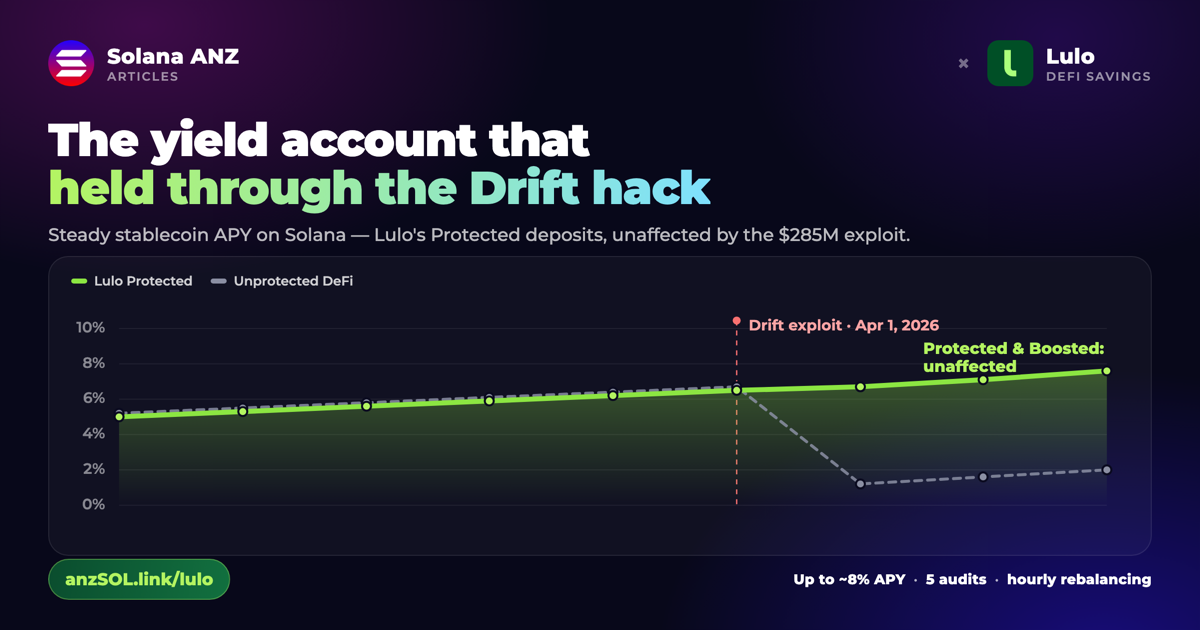
Most people in crypto want the same boring thing traditional finance promised and never delivered: a savings account that actually pays. Somewhere to park stablecoins, earn a real rate, and not lie awake wondering whether the protocol underneath just got drained overnight. Lulo is the closest thing Solana has to that account — and in April 2026 it proved it under the worst possible conditions.
What Lulo actually is
Lulo (formerly FlexLend) is Solana's lending aggregator. Instead of asking you to pick a lending protocol and babysit its rate, it does the picking for you. Deposit a stablecoin and Lulo spreads it across the top lending and yield venues on Solana — the likes of Kamino, MarginFi, Drift, Jupiter, Morpho, Maple and Pendle — then rebalances roughly every hour, chasing the best available yield as rates move. You get one balance that quietly compounds; the routing happens under the hood.
Think of it as a high-yield savings account that reads the whole market for you and always parks your money where it earns most, weighted by how much liquidity and risk sits behind each rate.
The rate is the point
This is where Lulo earns its keep. Because it is constantly moving to the best rate rather than sitting in one pool, yields have run up to roughly 8% APY on stablecoins — with fee-free, real-time compounding that leaves a bank savings account looking like a rounding error. As of writing, Lulo's Protected deposits were paying around 4.8% and its higher-octane Boost pool around 8.3%; rates are live and float with the market, but the direction of travel is clear.
The fee model is refreshingly plain: no deposit fees, no withdrawal fees, no hidden costs — just a 10% performance fee on the yield you actually earn. If you make nothing, you pay nothing. And because Lulo compounds in real time, you are not waiting on weekly epochs to see your balance move.
Reliability you can inspect
Yield means nothing if the thing holding your money is fragile. Lulo has leaned hard into the opposite reputation. It has been independently audited five times — by Certora, Halborn, OtterSec, Offside Labs and Sec3 — which is a heavier audit load than most protocols many times its age.
More interesting is the design of Lulo Protect. Deposits split into two tiers: a Protected pool and a higher-yield Boost pool. If any single integrated protocol takes a loss, the Boost pool absorbs it first — a loss-absorption buffer built so that Protected capital stays whole even when something underneath breaks. Boost earners take more upside and more risk; Protected earners trade a little yield for a cushion. It is insurance re-drawn as protocol design, and it is not just a whitepaper diagram.
The stress test: surviving the Drift hack
On 1 April 2026, an attacker gained privileged admin control of Drift Protocol and drained an estimated $285 million — more than half of Drift's total value locked. It was the largest crypto exploit of 2026 and the second-largest in Solana's history, behind only the 2022 Wormhole bridge hack, and it has been linked to North Korean state actors. Because Drift is one of the venues Lulo routes into, this was exactly the scenario the sceptics warn about: what happens to an aggregator when one of its integrations blows up?
The answer, for Lulo, was the one it had promised. Lulo flagged that users of its unprotected Classic deposits could see impact from the Drift exposure — but its Protected and Boosted products came through unaffected. The loss-absorption design did precisely what it was built to do: contain a single-protocol failure so that protected depositors did not eat the loss. A hack that wiped out half of Drift's TVL was absorbed rather than passed through. You can draw yield diagrams forever; watching the model hold during the worst Solana hack of the year is a different kind of evidence.
Try Lulo through Solana ANZ
If you want to put idle stablecoins to work, start here and the ANZ community gets credit for the referral:
The ANZ angle
For builders and holders across Australia and New Zealand, Lulo is the un-glamorous tool that just makes sense: a place to earn a real, compounding rate on stablecoins without becoming a full-time DeFi analyst, with an audit trail and a protection model that has now been tested by fire. It is the kind of infrastructure the ANZ community can actually use day to day — treasury for a small team, a yield parking spot between deals, or simply a savings account that pays like it is 2026.
Kick the tyres at anzSOL.link/lulo, read the docs so you understand the Protected-versus-Boost trade-off, and as always — tell them the ANZ community sent you.
Written by the Solana ANZ team. Nothing here is financial advice. Do your own research.